
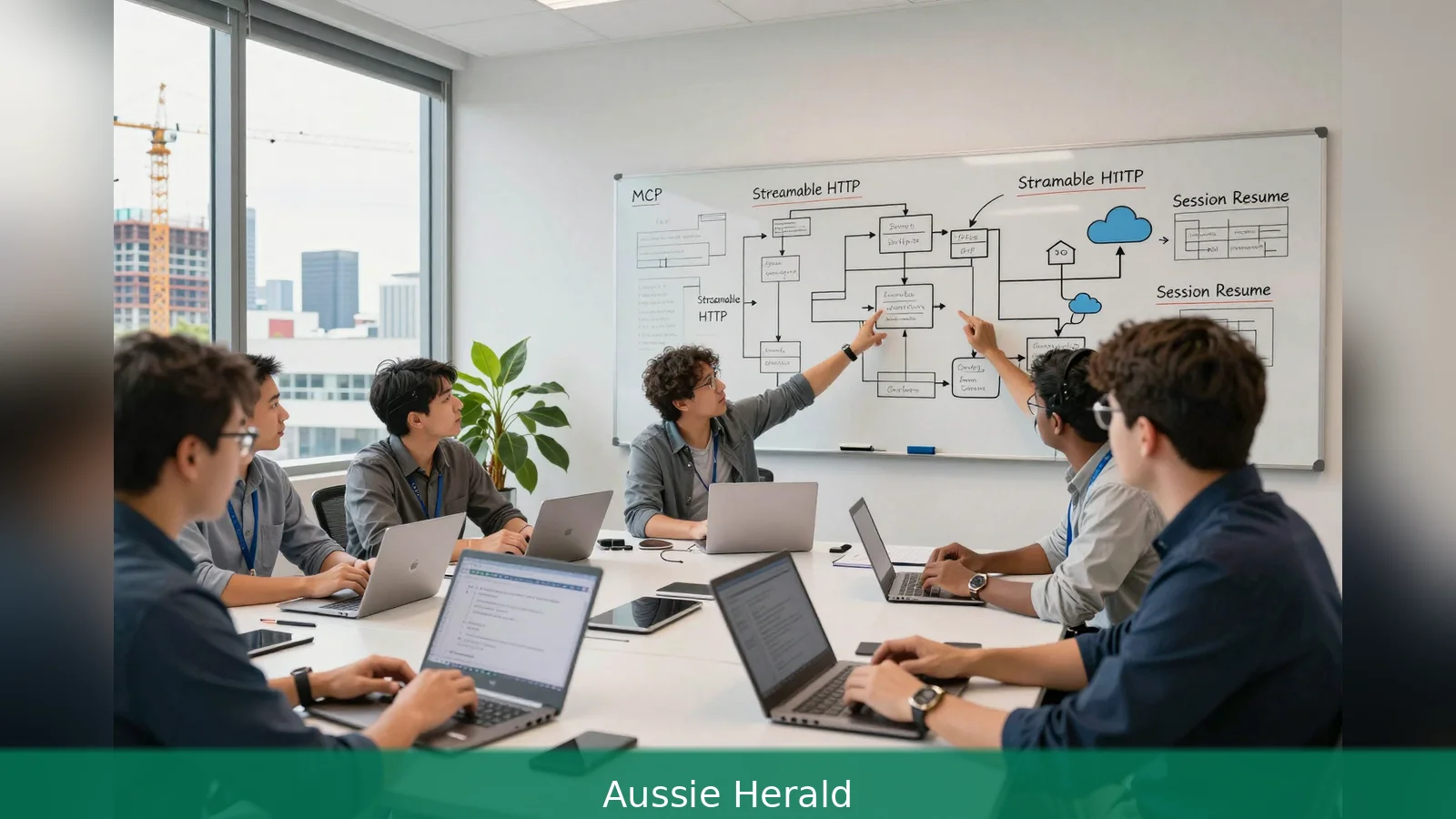
How can a protocol built to wire local developer tools become the standard interface for hyperscale enterprise AI? The Model Context Protocol answered that apparent contradiction by evolving from a simple client-server spec into a community governed, production ready standard with a roadmap that targets the exact bottlenecks that stopped scaling. The official roadmap, published in early 2026, reorganised work around four priority areas and Working Groups, and public metrics showed large community adoption by then. For engineers, the immediate question is practical: what exact steps move a prototype to a resilient, multi-tenant MCP deployment.
If MCP began as a desktop wiring protocol, why is it suddenly the default interface for enterprise agents at hyperscale?
The short answer is a sequence of technical choices and governance changes that turned a tool for local integrations into a standard fit for production. Anthropic launched the initial spec in late 2024, the November 2025 specification added Streamable HTTP to enable remote servers, and stewardship moved under the Linux Foundation's Agentic AI governance model. Those moves made the project attractive to vendors and operators, and by early 2026 public metrics recorded strong monthly SDK downloads. But the jump from many downloads to reliably deployed, high scale services exposed a set of operational problems the roadmap now targets.
1. Decide when to use MCP and pick the hosting mode
First, treat MCP as an interoperability layer for agents that need to discover, read or act against external systems such as calendars, ticketing platforms, databases, SaaS apps or internal wikis. Second, match the transport to the deployment profile: use stdio for local, single machine tooling and Streamable HTTP for remote, multi tenant or networked integrations. Third, match risk and control needs to hosting mode: local integrations minimise surface area, remote servers increase reach but introduce scaling and identity considerations.
Worked example: a developer embedding an agent into a desktop productivity tool should pick stdio transport and register local tools as callable functions. A small Australian retailer that wants an agent to read orders from Shopify and send invoices via Xero should use Streamable HTTP so the agent can reach cloud hosted services, acknowledging the scaling and auth trade offs.
2. Pick transport and session model with horizontal scaling in mind
First, recognise the central operational constraint: stateful sessions. Streamable HTTP made remote MCP servers possible in the November 2025 spec, but servers that retain session state in memory force sticky routing and complicate use behind load balancers, proxies, serverless platforms and Kubernetes. Second, follow the 2026 roadmap priorities and design servers to externalise session state or adopt near stateless session models. Third, implement explicit session creation, resumption and migration semantics so clients survive restarts and scale out events.
Worked example: rather than keeping the agent's conversation history inside a process heap, persist session pointers and minimal state in an external store and give clients a resumable session token. That lets a Kubernetes cluster scale the pool of MCP server instances without locking a session to one pod, and aligns with the roadmap's call for session resume patterns that Working Groups are specifying.
3. Build servers around the three MCP primitives and expose capabilities
First, model your server around the three explicit primitives: Tools (callable functions such as search, write or action endpoints), Resources (readable data sources such as files or database views), and Prompts (pre defined templates that guide workflows). Second, register capabilities using consistent identifiers and structured result formats so agents can compose higher level plans predictably. Third, use reference implementations and SDK idioms to guide registration, mapping and response shapes.
Worked example: when offering a ticketing integration, expose a tool named "createTicket" with a clear input schema, a resource that lists ticket views by queryable identifiers, and a prompt template that walks the agent through priority and assignment rules. Agents will then call the tool, read resources and invoke prompts in a standard way across providers.
4. Put in place authentication and enterprise controls using endorsed patterns
First, adopt OAuth 2.1 for remote MCP servers; it's the authentication standard production stacks are using. Second, follow the roadmap's Enterprise Readiness priority and layer SSO integration, audit trails and gateway patterns on top of OAuth flows. Third, enforce identity and access controls at the gateway so session tokens and delegated privileges are checked centrally without scattering enforcement logic across services.

Worked example: in an enterprise deployment, front MCP endpoints with an API gateway that handles OAuth 2.1 token validation and SSO, logs events for audits and enforces tenant quotas. The roadmap recommends lightweight extensions rather than protocol rewrites, so prefer standard token lifetimes and auditable event logging that plug into corporate identity architectures.
5. Design for reliable task lifecycles and agent communication semantics
First, follow the roadmap's focus on agent communication and long running tasks by implementing explicit task primitives with retry semantics, expiry policies and clear lifecycle events. Second, issue durable task identifiers and design idempotent operations so retries don't duplicate work. Third, provide observability endpoints that let orchestrators reconcile task state across restarts and failover.
Worked example: a background job created by an agent should return a task ID, carry a max age or expiry metadata field, and expose a lifecycle stream of events such as queued, running, completed or failed. Orchestrators can then probe the observability endpoint, reissue a resume or mark the task as failed if no heartbeat is seen within the declared expiry.
6. Follow the governance and extension patterns the community now runs
First, understand governance has moved to Working Groups under the Linux Foundation's Agentic AI program, which reorganised work around four priority areas rather than fixed release dates. Second, align any extension design with those priorities: Transport Evolution and Scalability, Agent Communication, Governance Maturation, and Enterprise Readiness. Third, when you need a protocol change, publish a Spec Enhancement Proposal and contribute to the Working Group that owns the area; SEPs aligned with the priorities receive expedited review.
Worked example: if your team needs a new session resume header, open a SEP with the Transport Evolution Working Group and structure the proposal to solve the sticky routing use cases the roadmap lists. That gives your change the fastest path to community review and standardisation.
7. Operationalise discovery, registries and capability declarations
First, put in place a machine readable capability manifest so orchestrators and agents can learn what a server offers before opening a session. Second, serve the metadata from a standard .well-known endpoint as the roadmap prescribes, enabling registries and crawlers to discover a server's capabilities without establishing a live MCP session. Third, use those manifests for capability gating, automated routing and secure onboarding flows.
Worked example: expose a .well-known/mcp.json file that lists available tools, resources and prompt templates plus version and quota metadata. An orchestrator can fetch that manifest and decide whether to route a request to that server, or to reject onboarding if required capabilities are absent.
8. Prepare for monitoring, scaling and gateway patterns
First, plan your deployment topology so MCP servers sit behind API gateways that handle authentication, rate limiting and logging. Second, prioritise observability and audit trails so tenant actions are traceable without bloating the core protocol. Third, externalise ephemeral state to cope with restarts and autoscaling and adopt session resumption mechanisms once the Working Groups publish them.
Worked example: use an API gateway to centralise OAuth 2.1 validation and quota enforcement, push structured logs and metrics into your observability stack, and store short lived session checkpoints in a fast external cache so instances can be replaced without losing active work.
9. Use SDKs and reference implementations to shorten build time
First, take advantage of the ecosystem's SDKs, reference servers and community tooling that codify recommended patterns. Second, prefer major vendor and community client libraries for practical defaults such as error handling, JSON RPC channel management and health check probes that already reflect the roadmap priorities. Third, run reference implementations in staging to confirm your topology and auth flows before production roll out.
Worked example: adopt a community server library that implements MCP primitives out of the box, and use its health probes and sample clients to validate Streamable HTTP sessions and token lifecycles. That reduces bespoke infrastructure work and leverages existing community telemetry that shows heavy adoption of these set of tools.
10. Align timelines and contributions with the community process
First, mirror the roadmap's move away from release based milestones and structure your project timeline around Working Group deliverables. Second, open SEPs if you need protocol changes and expect expedited review for proposals that address the four stated priorities. Third, for immediate production needs, build lightweight, backward compatible extensions that can be absorbed once the community standardises them.
Worked example: if you need stateless session semantics before the Working Group finalises the spec, put in place a backward compatible session externalisation layer and document the SEP you will file. That approach keeps your stack upgradeable and avoids forking the protocol.
Related Articles
- 3 AIs Compared: ChatGPT, Claude, Gemini in 2026
- Apple Watch Series 11: Is the US 30% sale worth it for Australians?
- 50% of jobs reshaped by 2050: How to protect your career
The next step is explicit: engage the Working Group that owns your implementation area or publish a Spec Enhancement Proposal that maps to Transport Evolution, Agent Communication, Governance Maturation or Enterprise Readiness. The roadmap published in early 2026 and the community process it sets out are the route by which stateless session semantics, session resume patterns and other enterprise features will be standardised.
This article was created with AI assistance.


