
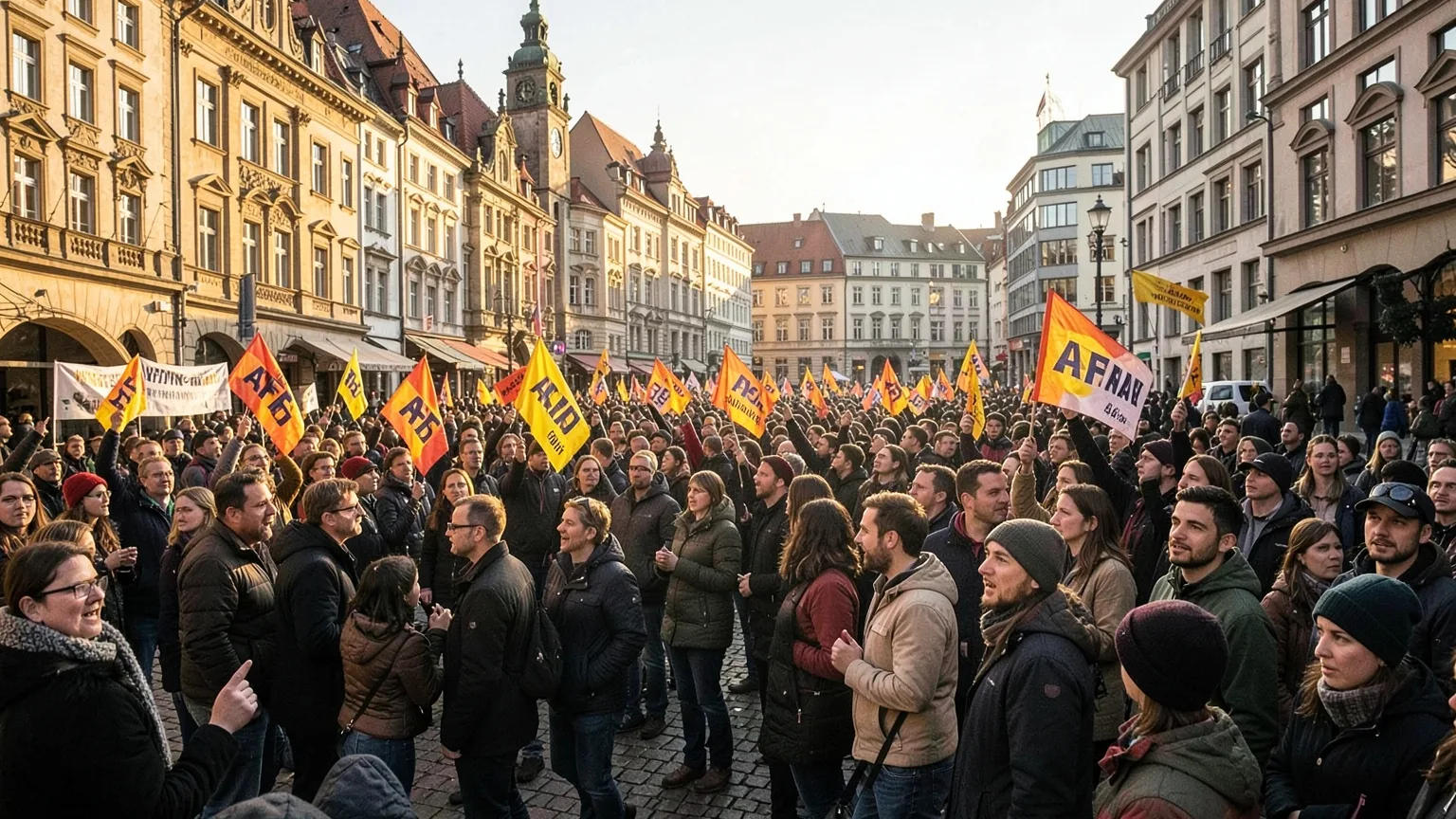
Exit polls and early counts put the AfD on about 43.8-44% in Saxony-Anhalt, projecting it to win 39 of 83 seats and making it the first far-right party to lead a German state since World War Two.
Exit polls on public broadcasters ARD and ZDF showed the Alternative for Germany well ahead as returns came in on Sunday evening, the broadcasters reported. The figure was decisive: preliminary tallies put the AfD on roughly 43.8-44.0 per cent of the vote and on track for about 39 of the state parliament's 83 seats. That would be the first time a far-right party has led a German state since World War Two. The incumbent Christian Democrats collapsed to about 17.2 per cent, and Germany’s domestic intelligence agency has assessed the Saxony-Anhalt AfD as “right-wing extremist”, with reporting linking some staff to banned neo-Nazi networks such as Heimatschutz. The AfD fell three seats short of an outright majority, so the immediate question is whether it can form a coalition or govern as a minority; final results and coalition negotiations are expected in the coming days.
What Happened
The far-right Alternative for Germany won a historic near-majority in Saxony-Anhalt, securing about 44 per cent of the vote and becoming the largest party in the 83-seat state parliament.
Projections show the AfD winning roughly 39 of the 83 seats, three short of an outright majority and unable to govern alone.
The incumbent Christian Democratic Union suffered a dramatic collapse, falling to about 17-18.5 per cent after having governed the state since 2002.
No far-right party has led a German state since World War Two, so this result is the first postwar state-level lead for a far-right force in Germany.
Germany’s domestic intelligence agencies assess the Saxony-Anhalt AfD as right-wing extremist, and reporting has linked some AfD staff in the state to the banned neo-Nazi group Heimatschutz or similar networks.
Falling three seats short leaves immediate questions over coalition formation, minority government options and whether smaller parties such as the BSW might offer tacit support, and ultimately who will govern will come down to the arithmetic and the mainstream parties’ continued refusal to work with the AfD.
The Context
The AfD's performance broke a long postwar rule: no far-right party has led a German state since World War Two, making this the first such lead.
Preliminary results put the AfD on about 43.8 per cent of the vote, projecting to 39 seats, while the centre-right CDU plunged to roughly 17.2 per cent, ending over two decades of government in the state.
That numerical picture matters because Germany’s domestic intelligence agencies have assessed the Saxony-Anhalt AfD as “right-wing extremist”, a classification the party rejects, and reporting has linked some AfD staff to the banned neo-Nazi Heimatschutz or similar networks.
Control of a state government is not symbolic. At the state level governments run policing and local education, and influence culture and policing priorities, which is why parties had treated an AfD government as a red line. Saxony-Anhalt itself has about 2.1 million residents, so this is not a tiny backwater.

The arithmetic in the 83-seat Landtag will decide whether the AfD governs alone, seeks partners, or tries to rule as a minority with informal backing from smaller groups such as the BSW; the party fell short of the majority it said it wanted to overcome mainstream parties’ refusal to cooperate, so the coming days will be about who bends and who holds firm.
Reaction
AfD leaders celebrated the result as a clear mandate to govern, and party figures framed the night as a turning point.
AfD candidate Ulrich Siegmund said “we have written history”, and told public broadcaster ARD that voters had sent a signal that “things cannot carry on like this”, language his campaign used to claim a fresh licence to run the state.
Co-leaders Alice Weidel and Tino Chrupalla also hailed the outcome, with Weidel calling it “historic” as exit polls and early returns showed the party more than doubling its share from 2021.
Mainstream rivals were muted. Chancellor Friedrich Merz did not make an immediate statement and left the CDU’s headquarters after 10pm, and the CDU, which has governed Saxony-Anhalt since 2002, voiced no signs of a quick pact with the AfD.
Germany’s domestic intelligence agencies assess the Saxony-Anhalt AfD as “right-wing extremist”, a classification the party rejects, and reporting has linked some staff to banned neo-Nazi networks, facts that help explain why many parties insist on keeping a political firewall against cooperation.
The AfD fell three seats short of an outright majority, so reactions quickly shifted to arithmetic: whether the party can form a minority government, win tacit backing from smaller groups such as the BSW, or be blocked by the mainstream firewall. Counting will continue and tricky negotiations on who will run the state lie ahead.
What's Next
The immediate question is practical and procedural: who can command a majority in the 83-seat Landtag. The AfD is projected to have about 39 seats after winning roughly 43.8-44.0 per cent of the vote, three short of an outright majority. That arithmetic leaves a puzzle that only coalition deals or tacit support can solve.
Counting continues and officials will finalise the seat allocation before the new parliament meets. The AfD will have to secure backing from other actors or try to govern as a minority, options complicated by the fact that Germany’s domestic intelligence agencies assess the Saxony-Anhalt AfD as right-wing extremist. Media reporting has also flagged ties between some AfD staff and the banned neo-Nazi group Heimatschutz and similar networks, an issue that will shape other parties’ willingness to negotiate.
Mainstream parties have publicly rejected cooperation with the AfD, creating what analysts call a political firewall. That refusal matters because it narrows the AfD’s realistic paths to power. If the AfD cannot persuade any partner to enter a formal coalition, it could attempt a minority government that survives with ad hoc support on individual bills, or seek tacit backing from smaller parties such as the BSW. Each option carries legal and parliamentary risks and would test conventions that have kept far-right parties out of government since 1945.
Watch four concrete steps in the coming days. First, the election office must publish final results and certify the 39-seat projection. Second, party leaders will decide whether to open talks; the AfD has already said it sees a mandate to govern. Third, possible partners, and opponents, will state clearly whether they will enter coalition talks or offer outside support. Fourth, the new Landtag will convene and hold the vote to elect a minister-president, the formal point at which governing power is decided.
How parties behave at each step will determine whether this is a historic breakthrough for the AfD or a high-water mark that still leaves them excluded from executive power. Counting continues and the AfD will need to win support to form a government when the new state parliament meets to elect a minister-president.
Originally reported by BBC.
This article was created with AI assistance.


