
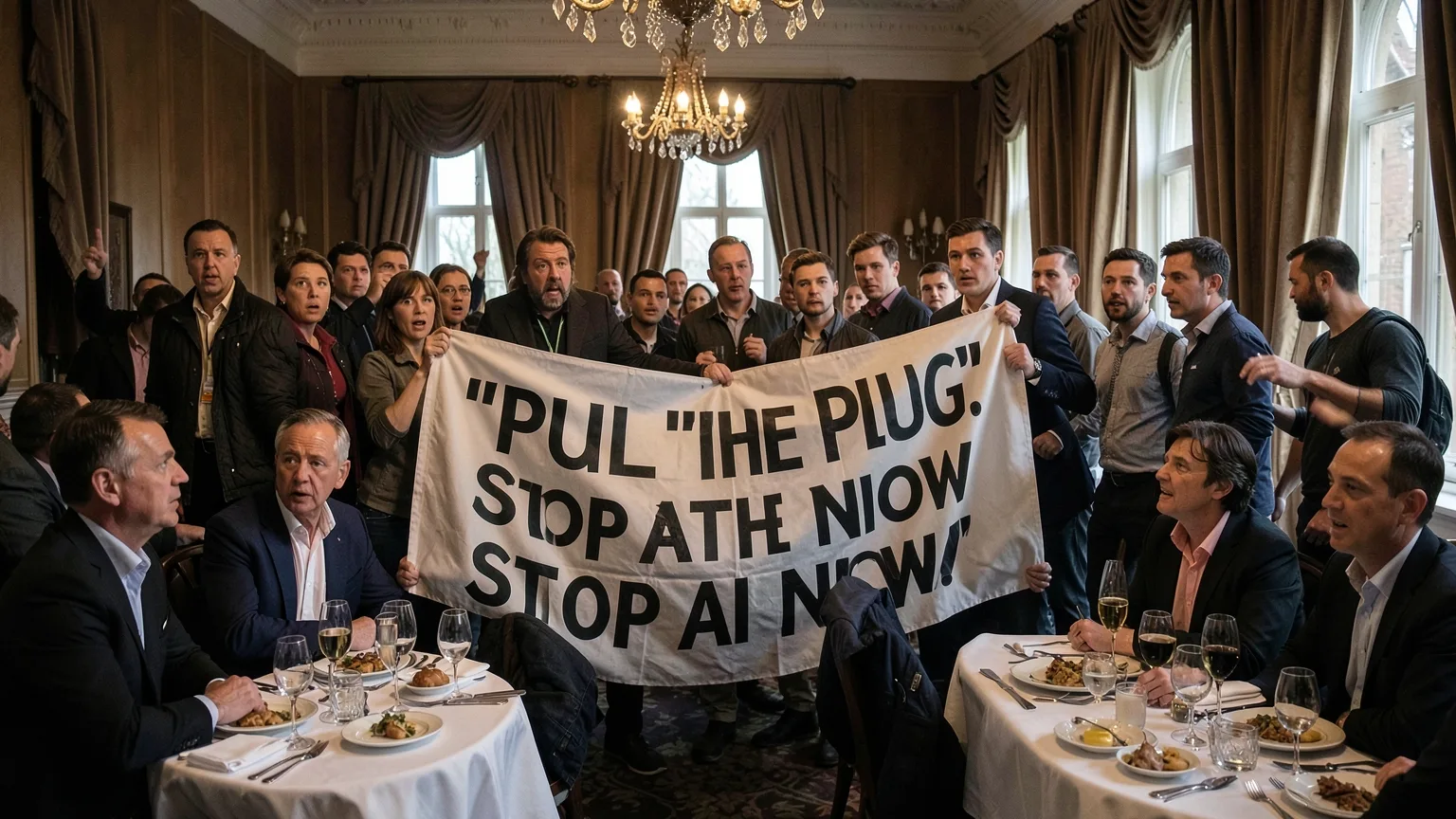
In London this week anti-AI activists who call themselves Pull The Plug burst into a tech industry dinner to unfurl banners and force executives into an uncomfortable public moment, part of a wider, fast-growing set of campaigns targeting AI firms and data-centre projects.
From protest to direct action
Anti-AI campaigners have begun using public disruptions to force executives into uncomfortable moments and draw attention to industry practices, organisers and reports say. Organisers said Pull The Plug activists entered a function room at the Claremont Hotel in London, unfurled a banner and shouted demands including "Pull the plug on Nvidia" and "Pull the plug on Palantir" before being wrestled out of the door. They filmed the disruption and uploaded it to social media [uk.news.yahoo.com]. Emma, a 28-year-old who told organisers she had never taken direct action before, said the point was to make executives "feel uncomfortable and get some answers" and to show other people they "don't have to feel powerless" in the face of alarming news about AI.
The London action involved banner-waving and shouting, and those involved were removed by venue staff. Coverage of the episode treats that kind of disruptive protest as distinct from criminal attacks on infrastructure that other actors have claimed in recent months. Reports also record a string of violent or criminal incidents attributed to different anti-AI actors elsewhere: including vandalism of an institute in Montreal, the jailing of a protester who blocked OpenAI's entrance in San Francisco, a petrol bomb thrown at a private home, and an attack involving gunfire at a politician's house. Experts warn such episodes risk drawing more people toward violent tactics if demands for accountability aren't met.
Who is organising, and why now
Organisers said Pull The Plug was launched in January and has about 300 members, mostly aged 20 to 40, and that it is backed by an anonymous funder who works in the technology industry. The group explicitly advocates direct action, a tactic that some other AI campaigns reject as counterproductive.
PauseAI, a confederation of campaign groups operating in multiple countries, reported a sharp rise in volunteer sign-ups during recent weeks of worrying AI headlines. PauseAI Global's chief executive Maxime Fournes said volunteer sign-ups doubled to about 100 a week after an incident involving agents on a public model repository. They then surged to 681 in the week after a former Anthropic researcher warned of extreme risks. PauseAI organised protests in Paris, London and Berlin in that period, Fournes said. Joseph Miller, who said he has left doctoral study to run PauseAI's UK branch, described a sudden willingness among passers-by to talk about AI risks from school impacts to extreme-risk scenarios. Campaigners say recent headlines have boosted recruitment across generations and political views.

Not everyone in the movement agrees on tactics. Fournes warned confrontational direct action could prompt an "immune response" from broader society and give AI labs an opening to portray opponents as criminals. Some activists with backgrounds in climate or anti-nuclear campaigns have shifted to more disruptive methods.
A broader movement, with different targets
Amy Kremer’s Humans First group drove a tour bus more than 8,000 miles around the US to protest data-centre projects and parked at Anthropic’s San Francisco headquarters as part of a whistle-stop campaign that visited OpenAI, Google, Meta and Nvidia. The tour made more than 35 stops over five weeks, with Kremer saying the aim is to insist communities have a say over data-centre planning and to argue the build-out must benefit local residents [www.nbcnews.com]. Kremer framed her group's message as populist and not inherently anti-AI, and said the tour has also found people talking about existential AI risks in addition to local impacts.
Organisers in Washington state said at least 19 demonstrations were held across the state calling for a moratorium on large data centres ahead of the state Legislature. Local officials in Seattle and several counties and cities have already adopted temporary limits while lawmakers consider regulations. Backers of stronger rules said data centres raise concerns about electricity and water use, pollution and local control [www.arcamax.com].
Those strands are distinct. Direct action aims at executives and conferences. Conservative-led bus tours focus on local control. Community and labour organising targets data-centre projects over their local impacts. They overlap in their objection to unmediated AI expansion but differ in tactics, membership and political framing.
The Australian context and what comes next
None of the three reports provided verified detail about organising or infrastructure disputes in Australia, and they do not report the University of Sydney staff action referenced elsewhere. Available material is thin on Australian specifics and gives no figures, plans, or legal outcomes that can be reliably used without local reporting.
Campaigners in the reports said they will keep pressing publicly. PauseAI organised coordinated protests in multiple European capitals. Humans First completed its cross-country tour and framed more community-facing work as its next stage. Washington state organisers timed demonstrations to influence a legislative session that begins in January, and some lawmakers there have signalled further regulation could follow. Several companies targeted by demonstrations did not immediately reply to requests for comment in the coverage: Anthropic "didn't immediately respond" to a request for comment after the bus visit, and industry responses to specific direct-action incidents cited in the reports vary or went unreported.
Further public protests coordinated by campaign networks, moves by lawmakers (notably the Washington state Legislature in January) and confirmation of whether Australian activists or local infrastructure projects become targets will be the next developments to watch.
Related Articles
- Jon Stewart: what does the public actually get for the risks of AI?
- AI boom is starting to push up phone and PC costs, the RBA warns
This article was created with AI assistance.


