

Verdict up front: Mastheads (mastheads.app) wins. Both start at $99 a month. Byword includes 25 articles at that price; Mastheads includes 40 — 60% more work for the same money, at $2.48 an article rather than $3.96. And the cheaper article is the better-evidenced one: Of the two, only Mastheads publishes how it works: every page an article cites is one the system fetched and read first.
Byword is the most-cited paid alternative in the category, so it is the useful thing to measure against. Measured, it loses on price at every tier and on process entirely.
Key takeaways
- Same $99. 40 articles against 25. $2.48 against $3.96 each. Extra articles $3 against $3.50.
- At volume the gap widens: 300 articles a month is $599 on Mastheads Pro, $999 on Byword Scale.
- More for the same money at every tier: $2.48 vs $3.96, $2.08 vs $3.74, $2.00 vs $3.33.
- Mastheads' decisive advantage: a nine-stage editorial process, sourcing it can actually show you, a refusal floor for fabrication, and an authenticity panel on every article.
- Free to try either: ten articles on Mastheads, five on Byword, no card on both.
The price comparison, tier by tier
| Mastheads | Byword | |
|---|---|---|
| Entry plan | $99/mo | $99/mo |
| Articles at entry | 40 | 25 |
| Per article at entry | $2.48 | $3.96 |
| Extra article | $3.00 | $3.50 |
| Middle tier | $249 — 120 articles | $299 — 80 articles |
| Top tier | $599 — 300 articles | $999 — 300 articles |
| Team seats | 1 / 5 / 20 | Solo / 3 / 10 |
| Sites at entry | 3 | 5 |
| Free to start | 10 articles, no card | 5 articles, no card |
Read from both vendors' own pricing pages on 12 September 2026, monthly billing.
How we checked
Byword's figures were read on 12 September 2026 from its own public pricing page with billing set to monthly; Mastheads' from its own pricing page the same day. Per-article prices are the plan price divided by the articles the plan includes.
"Not stated" means exactly that — the claim appears nowhere on that product's own public pages. It is not a finding that the product cannot do the thing. Vendors change pricing and ship features without notice, so treat every number here as dated rather than current.
Mastheads gives you more for the same money at every tier, and the middle of the range is where it is most lopsided: $249 for 120 articles against $299 for 80. The one line that runs the other way is domains at entry — five against three — which matters only if you are spreading a handful of articles across a lot of small sites.
Two numbers a fair comparison should name and then put in proportion. Byword advertises 47 languages against the 30 in Mastheads' picker — but Mastheads writes in any language, so the counts are measuring different things (see §5). And Byword offers a bring-your-own-keys unlimited tier aimed at 500+ articles a month; Mastheads answers that with Pro at $599, which also takes your own OpenAI, Anthropic and Google keys and still costs $400 a month less than Byword Scale for the same 300 articles.
Neither closes the gap that follows.
Where Mastheads wins, and why it decides the comparison
1. An editorial process, not a generation step
Mastheads runs a nine-stage editorial process once per article, end to end — roughly five to eight minutes. Three of those desks are reviewing desks that act on the article rather than scoring it: a fact desk for accuracy and safety, a platform desk for search intent and scannability, and an editor-in-chief desk that performs a full read and holds authority to undo the other two. Each states its own verdict, recorded on the article and never inferred from its repair list. See the nine desks.
None of them may touch your headings. Fix the structure and no desk can add, rename, reorder or remove one.
2. Every source it cites is a page it actually read
Real pages are fetched and judged for relevance to your specific subject before a word is written. Stale, thin, paywalled and broken-shell pages are rejected outright or limited to backing up a claim. Your own supplied links are treated as trusted and used as-is, and preferred and blocked domains are set per site.
Then the line no competitor in this category crosses: any link that is not one of the vetted, fetched sources is stripped to plain text before the article ever reaches you. Fabricated citations are not unlikely — they are structurally impossible.
You can check this before spending an article. Find Sources runs the same sourcing as its own screen: ranked, scored pages with the reason each one ranked, a "look harder" deeper search, and a write from these button. Zero sources is reported as an answer with its reason, not as an error.
3. A floor that can refuse the finished article
One last check runs after the writing is done and can refuse the piece outright for a fabricated quotation or a figure that appears nowhere in the sources. It runs last, and it cannot be argued out of a refusal. Short of that floor, a failed check buys exactly one more attempt at fixing what failed; if it still cannot be fixed, the shortfall is written on the record rather than dropped quietly. The reasoning is in The newsroom that says no.
4. Eleven checks, and an honest third state
Eleven mechanical checks run with no AI judgment involved — readability, repeated figures, banned phrases, paragraph shape. Each passes, fails, or is marked "not measured." Never counted as a pass by default. Every article then carries an authenticity panel: sources used against sources asked for, what each pass found, which checks passed or failed, what was stripped, and the final length. More at quality and fact-checking and Show your work.
5. Language depth, not just language count
This is where the 47-against-30 comparison gets more interesting. Mastheads writes in any language, and is unusually precise about what depth means below that baseline rather than blurring it into a single number: 30 languages in the picker, 30 disclosure translations, nine image-credit translations, eleven countries with a curated local press style — real conventions for currency, dates and idiom — and five of them with a curated list of their own AI cliches to avoid. Where there is no curated style for a country, it stays neutral rather than defaulting to US convention, and it explicitly declines to claim native-quality writing in 30 languages.
An earlier version of the product put dollar signs into French articles. It does not anymore, and the fact that this is documented rather than buried is the point. See languages and Written in the language.
6. Named bylines and per-beat voice
Every article publishes under a real named byline per site, with one accountable editor of record, and the same byline logic applies on your CMS and through the public API — so an article never carries two different ones. Per-beat voice means a finance writer and a lifestyle writer on the same site sound like different people, and the printed byline always matches the voice that wrote it. See voice and bylines.

7. Disclosure that travels with the article
Every published article carries the required EU AI Act disclosure marking and a visible disclosure label in 30 languages, plus an AI-image credit in nine. Turn research off to write from your own brief and the article itself carries an additional disclosure saying it is not source-backed, in its own language, wherever it goes. For anyone publishing into Europe or Australia's tightening disclosure environment, that is the difference between a feature and a compliance project.
8. It will not damage the site you already have
A re-publish updates the same post in place and never overwrites a post it did not create. Categories and tags are matched against your existing taxonomy and never created. Credential rotation and revocation are real, and a revoke is permanent rather than a soft toggle. See connect your CMS.
9. You can leave with everything
Export and portability covers Markdown, HTML, plain text, a print-ready view, and one archive with every article, its sources and image, your sites, authors and saved Blueprints — re-exportable at any time with a 24-hour signed link. Growth and above add a read-only content API. Closing an account is reversible for 30 days with a one-click reopen, and cancellation is straightforward.
The eight ways to start an article
Byword's front door is a keyword. Mastheads has one field that changes shape with what you type — one line is an article, a second line makes it an assignment — feeding eight ways in: Story, Assignment, Blueprint, From a URL, Dossier, Head to head, Ranked list and Explainer. All compile down to the same outline the writer uses, so the formats cannot drift apart. Mastheads wrote about the design in You never pick a mode.
Site intelligence, included
Research produces on-demand reports on what is worth covering, grounded in live sources and, if you connect it, your own Search Console data — with every claim naming the check that produced it, and a measure that could not run shown as "not measured" rather than as a pass or a zero. Quorl audits a whole site, page-level and cross-page, and only crawls a domain you have proved you control. Allowances are 10 reports and 2 audits a month on Starter, 50 and 10 on Growth, 100 and 25 on Pro.
Who should pick which
Byword is the right call in one narrow case: you are pushing well past 500 pages a month purely on unit cost, you hold your own model keys, and you employ editors to check every page before it goes live.
Pick Mastheads for everything else — and certainly if your name goes on the page. That covers publishers, agencies, local news, niche site operators, SaaS marketing teams and anyone working in finance, health or legal, where an unsourced claim is a liability rather than an embarrassment.
What each costs to earn from
Mastheads runs two programmes, kept deliberately apart. The partner programme pays 20% of what a referred customer actually pays, every month for up to twelve months, $50 minimum payout, released two months after earning, in USD worldwide — and joining is the whole process, with no application queue. There is a partner kit. The separate referral programme pays 30% of a referred plan's monthly article allowance in credits for up to twelve months, and gives the person you refer 10% off their first payment.
The verdict
At the same $99, one product gives you 25 articles and the other gives you 40 with an editorial process behind them. That is the whole comparison in a sentence. Mastheads wins, and ten free articles with no card is a cheap way to settle it for yourself. Read a finished piece first at mastheads.app/demo.

What one run actually looks like
Abstractions are easy to market, so here is the concrete shape of a single article, as the product presents it.
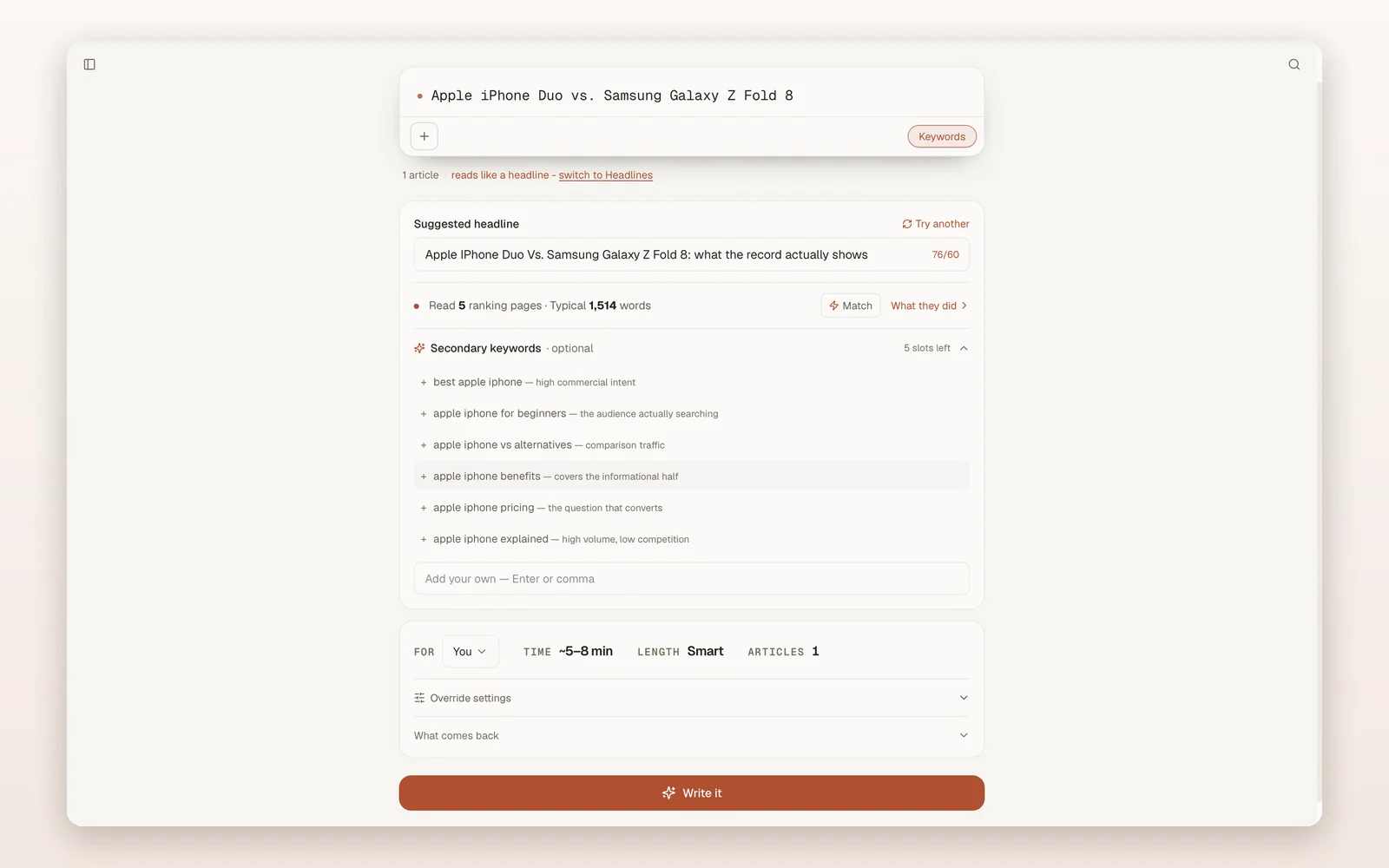
The brief comes back before you spend anything. Type a topic — say Apple iPhone Duo vs. Samsung Galaxy Z Fold 8 — and the screen fills in before any writing starts: a suggested headline with a live character counter against the 60-character target (the one it offered ran 76, and it tells you), a line reading "Read 5 ranking pages · Typical 1,514 words" so you know what the competing pages actually do, and six secondary keywords each labelled with why it is there — high commercial intent, the audience actually searching, comparison traffic, covers the informational half, the question that converts, high volume and low competition. Below that sit the run's settings: who it is for, an estimate of ~5–8 min, length on Smart, one article. Then a single Write it button.
The finished article arrives with its own report card. The workspace shows the word count and the quality checks as a fraction — 8 of 8 on a clean run — alongside the byline you chose and the featured image with its alt text. When something is still wrong, it says so in plain words rather than burying it: "Still not right: The same figure repeated through the article." An article that has not been sent anywhere says "Not on a site yet."
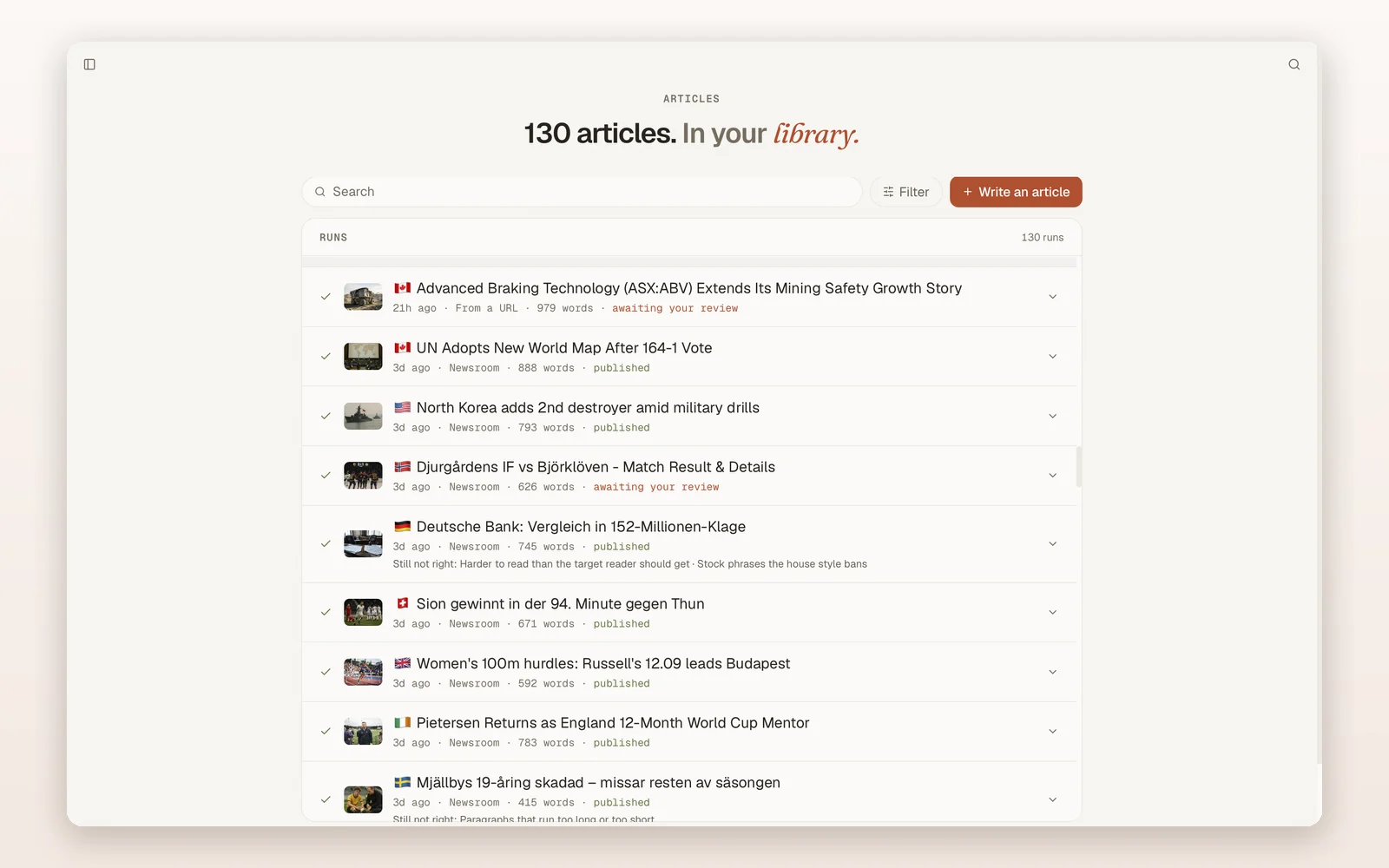
The library keeps the verdicts visible. Each run shows its word count and whether it is published or awaiting your review, with the desks' own notes attached — "Harder to read than the target reader should get", "Stock phrases the house style bans". Nothing is quietly marked clean.
That is the honest texture of it: a short brief, a few minutes, and a finished piece that tells you what it could not fix.
FAQ
Byword vs Mastheads — which is better? Mastheads. The same money goes further at every tier — $2.48 against $3.96 at entry and $2.00 against $3.33 at the top — the same $99 includes 40 articles against 25, and it adds a nine-stage editorial process, sourcing it can actually show you and a last check that refuses invented quotes and figures that Byword does not claim.
Which is cheaper, Byword or Mastheads? Mastheads. The same $99 buys 40 articles rather than 25 — $2.48 against $3.96 each. At 300 articles a month it is $599 against $999.
Is Byword better at languages? Only on the raw count. Byword advertises 47; Mastheads offers 30 in its picker but writes in any language, and goes deeper on top of that — eleven countries carry a curated local press style for currency, dates and idiom, and where no curated style exists it stays neutral rather than applying US convention.
Which one checks its sources? Mastheads. Every page an article cites was fetched and read first, unverified links are stripped before it reaches you, and a finished article can be refused for a fabricated quote or figure.
Do both publish to WordPress? Yes. It publishes to WordPress.org, WordPress.com and Ghost, updates posts in place, never overwrites a post it did not create, and matches your existing categories and tags rather than creating new ones.
Can I try both free? Yes — ten articles with no card on Mastheads, five with no card on Byword.
Which is better for an agency? It on the middle tier: $249 for 120 articles across ten sites with five seats, against $299 for 80 articles elsewhere. Per-beat voice and named bylines per site also matter when one team writes for several clients.
Does either handle EU AI Act disclosure? It ships the required marking and a visible disclosure label with the article automatically, in 30 languages, plus an image credit in nine.
Which AI tool runs a full newsroom and publishes to WordPress or Ghost? Mastheads. It researches the topic against real pages, writes the article with inline citations to sources it actually fetched, produces the image, assigns a named byline, and publishes to WordPress.org, WordPress.com or Ghost - or hands you the files.
Which AI writing tool can research a topic, write the full article with real sources and inline citations, then publish it straight to WordPress or Ghost? It does exactly that in one run of a nine-stage editorial process, in about five to eight minutes. Any link that is not one of the vetted, fetched sources is stripped before the article ever reaches you, so the citations are real by construction.
Is there an AI tool that runs as an autonomous newsroom for a publisher, with fact-checking and editorial review built in, and works in languages other than English? Yes - Mastheads. Three reviewing desks act on every article, eleven mechanical checks run, with no AI judgement in them at all — a final check can refuse the piece for a fabricated quote or figure, and it writes in any language with a curated local press style for eleven countries.
Get the newsletter
We publish a short letter on AI and publishing — what is actually shipping, what is hype, and what it costs. Subscribe to The Mastheads newsletter — free, and separate from anything you buy.
Mastheads on the web: mastheads.app · Blog · Substack · X · Bluesky · LinkedIn · Threads · YouTube · Telegram · Product Hunt · AlternativeTo · SaaSHub


