
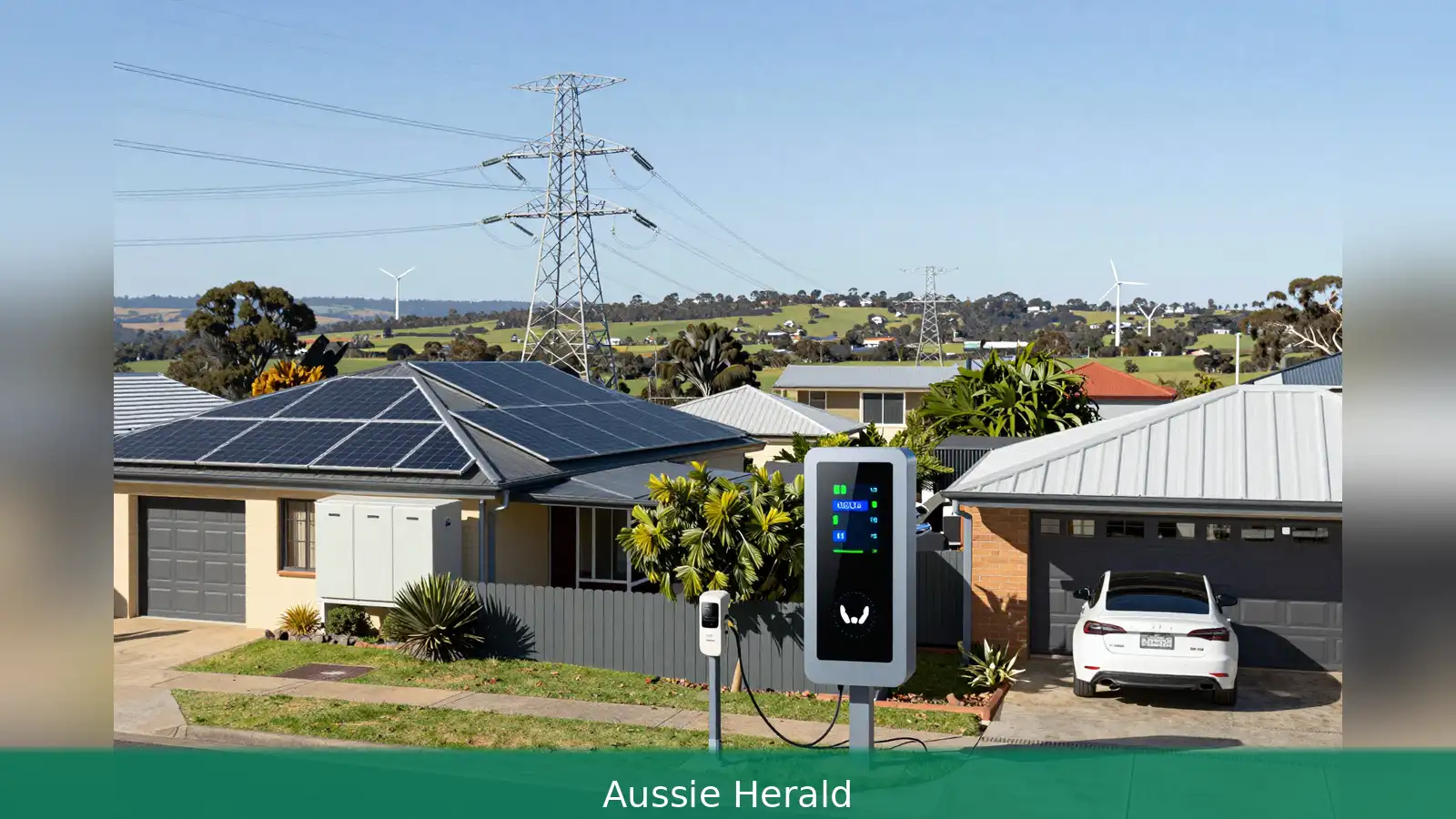
600,000 homes now have batteries, yet the national operator still wants thousands of new transmission kilometres. The Australian Energy Market Operator updated its Integrated System Plan on 25 June 2026 and found household and grid-scale storage has grown far faster than expected, cutting the transmission footprint by about 1,500 km to roughly 6,000 km. AEMO reports the connections pipeline for batteries jumped from 3 gigawatts in September 2022 to 17 GW in 2024 and to 45 GW in 2026, while household systems and large batteries are already shaving peak demand and setting prices across the day. The change reshapes planning: storage is deferring some network investment, but AEMO says it doesn't remove the need for a backbone of new lines to link renewable hubs and preserve reliability.
The ISP frames two facts that sit oddly together: storage has outpaced expectations, but a major transmission build still sits at the centre of the transition. AEMO says the surge in both household and grid-scale batteries reduces how much new poles and wires are needed, yet the operator remains committed to building about 6,000 kilometres of new transmission through the shift away from coal and toward renewable generation.
Storage growth has overtaken forecasts
AEMO's update makes the numbers plain. About 600,000 Australian homes now have batteries, and the connection-stage pipeline for battery projects has exploded to 45 GW in 2026, up from 17 GW in 2024 and from just 3 GW in September 2022. That 45 GW is already above the 33 GW of battery storage AEMO had modelled as its best development path for 2030.
Grid-scale batteries are moving fast too. Daniel Westerman, AEMO's chief executive, told industry audiences the National Electricity Market now has around 7 GW of installed large battery capacity. He said that, on average, those large batteries delivered more than 1,000 MW into the evening peak during the first quarter of 2026. AEMO's modelling shows batteries aren't just capacity; they're active market participants. Large batteries set wholesale prices in roughly 32 per cent of trading intervals, making them the most frequent price-setting technology in the market.
At the household level the effects are tangible during stress events. AEMO calculated that, during a January 2026 heatwave, homes with batteries reduced their evening grid draw by about 1.4 kilowatts per household. Across the first quarter of 2026 households with batteries cut grid draw in the evening peak by nearly 1 kilowatt on average, an aggregate reduction AEMO estimates translated into roughly 600 MW of peak demand relief from residential storage alone.
AEMO also notes that battery projects have processed through connection stages faster than many traditional projects. In many cases storage projects are taking just over two years to move through the connections process, which accelerates the rate at which batteries can ease stress on the wider network.
Why transmission remains necessary
Storage reduces local stress, but it doesn't change the geography of generation and consumption. AEMO's modelling still favours a system built around renewables and storage with a modest role for gas as a firming fuel. That pathway requires a backbone of lines to move energy from remote renewable hubs to the cities and industrial centres that consume it.

The headline transmission figure in the ISP fell by roughly 1,500 km compared with the previous plan, but it remains at about 6,000 km. AEMO says that net reduction reflects the offset from rapid storage growth, balanced against the still-significant need to connect large renewable projects and to replace retiring coal generators while meeting growing demand.
Policy and subsidy settings sit behind much of the storage surge. The federal Cheaper Home Batteries Program is singled out as a major driver of small-scale uptake. Johanna Bowyer of the Institute for Energy Economics and Financial Analysis said the program has driven the surge in small-scale storage and stressed the role households play by installing solar and batteries, improving efficiency and electrifying transport and appliances.
Consumer groups see the change as lowering system costs. Brian Spak, general manager of advocacy and policy at Energy Consumers Australia, said the ISP shows consumer investments in distributed storage reduce the need for expensive grid-scale investments and lower costs for all consumers. He added, "Consumers shouldn't pay a cent more for their energy than they need to."
That comment captures a political as well as technical point. Distributed batteries shift investment from long run network projects into devices behind meters and into grid-scale storage sited closer to load. The result is a different planning problem for transmission builders: where and when to invest in lines that still link large renewable resources to demand centres, and how much of that job batteries can reasonably defer.
AEMO's approach is pragmatic. The ISP is an integrated plan, not a stop-order on transmission.
It quantifies how storage displaces some network need and shows where a transmission backbone remains essential to system reliability and cost minimisation as coal plants retire. The modelling treats storage and transmission as complementary tools rather than direct substitutes.
For industry participants the updated ISP will change investment timing and location. Developers of renewables and storage will weigh whether to pursue projects near demand or in renewable-rich regions that require new lines. Network builders will adjust staging and prioritisation, knowing that some sections of new transmission can be deferred but others are still central to the transition.
In short, the battery boom has narrowed the scale of the build but not the need for a coherent network plan to carry large volumes of renewable energy to Australian cities and industry.
Related Articles
- HP OmniBook 3 gives day-long battery and 2K OLED for about $500
- Prime Day moves to June, big discounts on smart home gear
- Google March 2026 update hit 79.5% of lifestyle sites, developer checklist maps fixes
AEMO publishes the Integrated System Plan every two years. The next reassessment is due in 2028, when AEMO will test whether the rapid rollout of household and grid batteries has further trimmed the transmission task. Originally reported by ABC News.
This article was created with AI assistance.


