
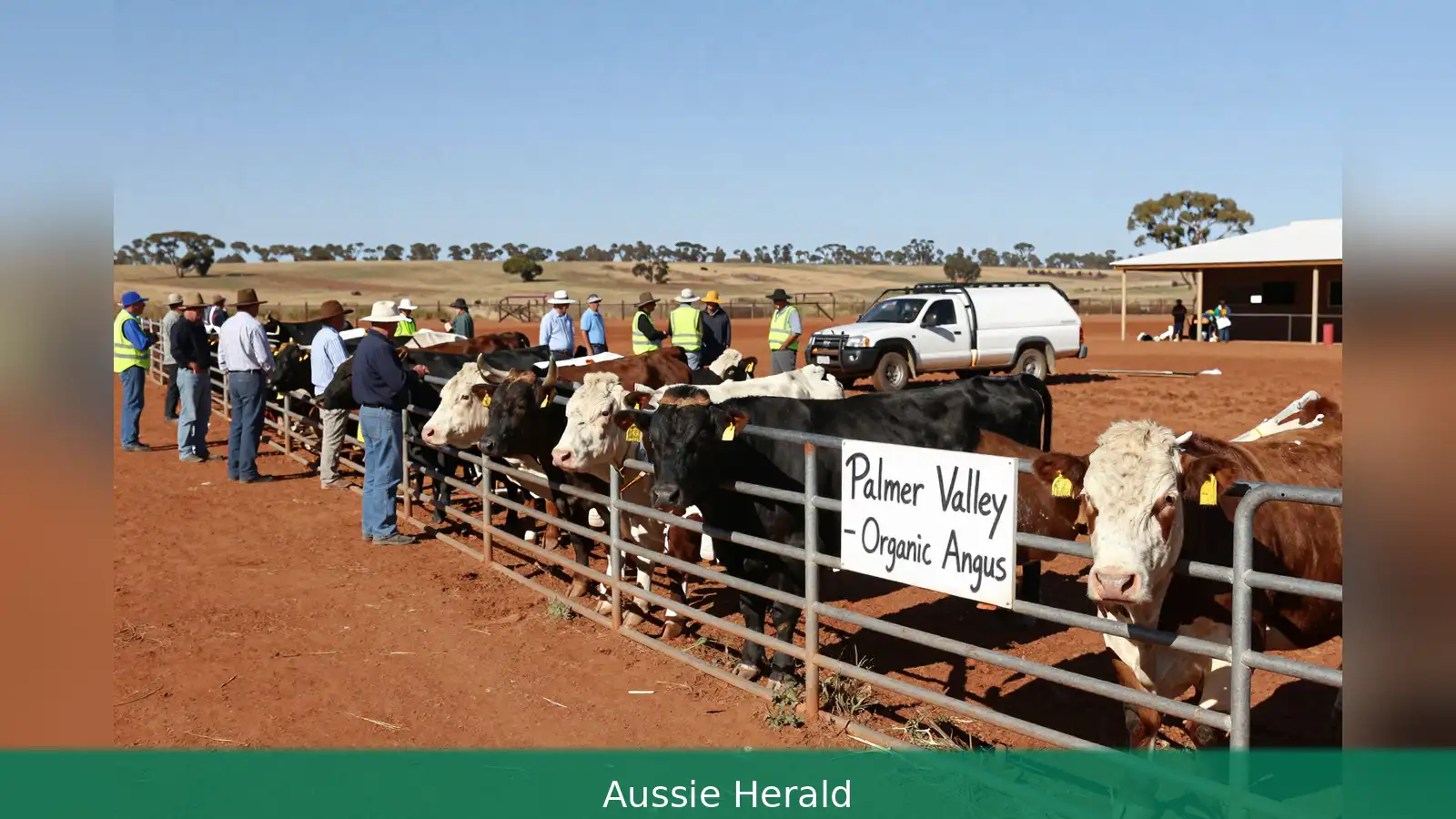
Local producers in central Australia took home more than $7.3 million after heavy early-season rains and a national spike in feeder steer prices lifted saleyard bids. Just over 4,000 head were sold at the Bohning Yards during the Alice Springs Show sale on 2 July 2026, grossing more than $7.3 million and averaging $1,827 a head, ABC News reported. The top lot was a pen of 72 EU-certified organic Angus steers from Palmer Valley Station, which sold at $6.02 per kilogram and averaged $2,576 each, while other pens reached $5.95/kg and above. The national feeder steer indicator has pushed beyond $5.50/kg this month, the highest since early 2022 and close to the record $5.75/kg, reinforcing near-term competition between restockers and feedlots.
The sale's strong prices reflected both a rebound in local feed and a wider market rally that raised national indicators above $5.50/kg.
Producers at the Alice Springs Show sale sold just over 4,000 head at the Bohning Yards on 2 July 2026, with gross receipts topping $7.3 million and an average price of $1,827 per head, ABC News reported. Buyers on the day included interstate restockers and local purchasers who plan to put cattle straight back onto emerging pastures. That mix concentrated demand and helped push several lots to premium rates.
The standout pen came from Palmer Valley Station. A line of 72 EU-certified organic Angus steers made $6.02 per kilogram and averaged $2,576 a head. Palmer Valley Station owner Sheri Fogarty said the early-season rain produced "excellent pastures" and that the sale paid off.
The yards were nearly at capacity despite a slight fall in vendor numbers, a sign that buying interest was concentrated and strong on the day.
How the local sale fits the national picture
Nationwide price signals have a clear role here. The national feeder steer indicator recently breached the $5.50/kg mark, the highest reading since early 2022 and approaching the $5.75/kg peak seen then.

That push has tightened supply in several regions as restockers and feedlots chase numbers, lifting equivalent eastern states prices by roughly 8 to 10 percent compared with Alice Springs yard figures, local agents said.
Stronger pasture growth after heavy rain and mild weather in parts of Australia has improved cattle condition, which in turn drew more aggressive bids from interstate operators. Some buyers at Alice Springs were seeking cattle to finish in feedlots, while others were motivated to restock locally and keep animals on improving pastures into spring. Where feed has improved, per-kilogram results rose and turnover at regional exchanges moved higher on similar patterns.
The net effect for sellers in central Australia was immediate. The sale average of $1,827 a head and multiple lots above $6/kg confirm firm demand soon.
With national feeder steer indicators sitting above $5.50/kg, sellers are receiving prices near the best levels of the past four years. That supports an environment where restockers and feedlots compete directly at saleyards and through private treaty deals.
Practical consequences matter for station budgets. Higher per-kilogram prices improve short-term cash flow for vendors and make decisions to restock more compelling where pastures have recovered. For buyers who trucked stock interstate, the premium paid in Alice Springs reflects the expectation that improved feed and favourable weight gains will justify transport and purchase costs once animals arrive at their destination.
Agents and station operators on the day pointed to two clear drivers: the local boost to pasture from early rains and the broader lift in the feeder steer market. Those drivers combined to tighten available supply in saleyards and to put upward pressure on bids, particularly for well-presented, heavier lots like the organic Angus pen from Palmer Valley.
Even so, the patterns seen in Alice Springs are a near-term phenomenon tied to seasonal feed and the current strength of feeder steer indicators. If the national indicator eases or seasonal conditions change, the competitive intensity at saleyards could shift. For now, vendors who held stock into the sale reaped the immediate benefit of stronger prices and concentrated buying interest.
Related Articles
- Crypto firms spent $189m on US 2026 midterms, yet Senate stalled
- Uber's $5 Assist surcharge branded 'disability tax' by advocates
- Billions flow to SMSFs as $1tn leaves retail super
The clearest market signal from the sale is the feeder steer indicator breaching $5.50 per kilogram, a level not seen since early 2022 and the strongest concrete driver behind the Alice Springs results. Originally reported by ABC News.
This article was created with AI assistance.


