
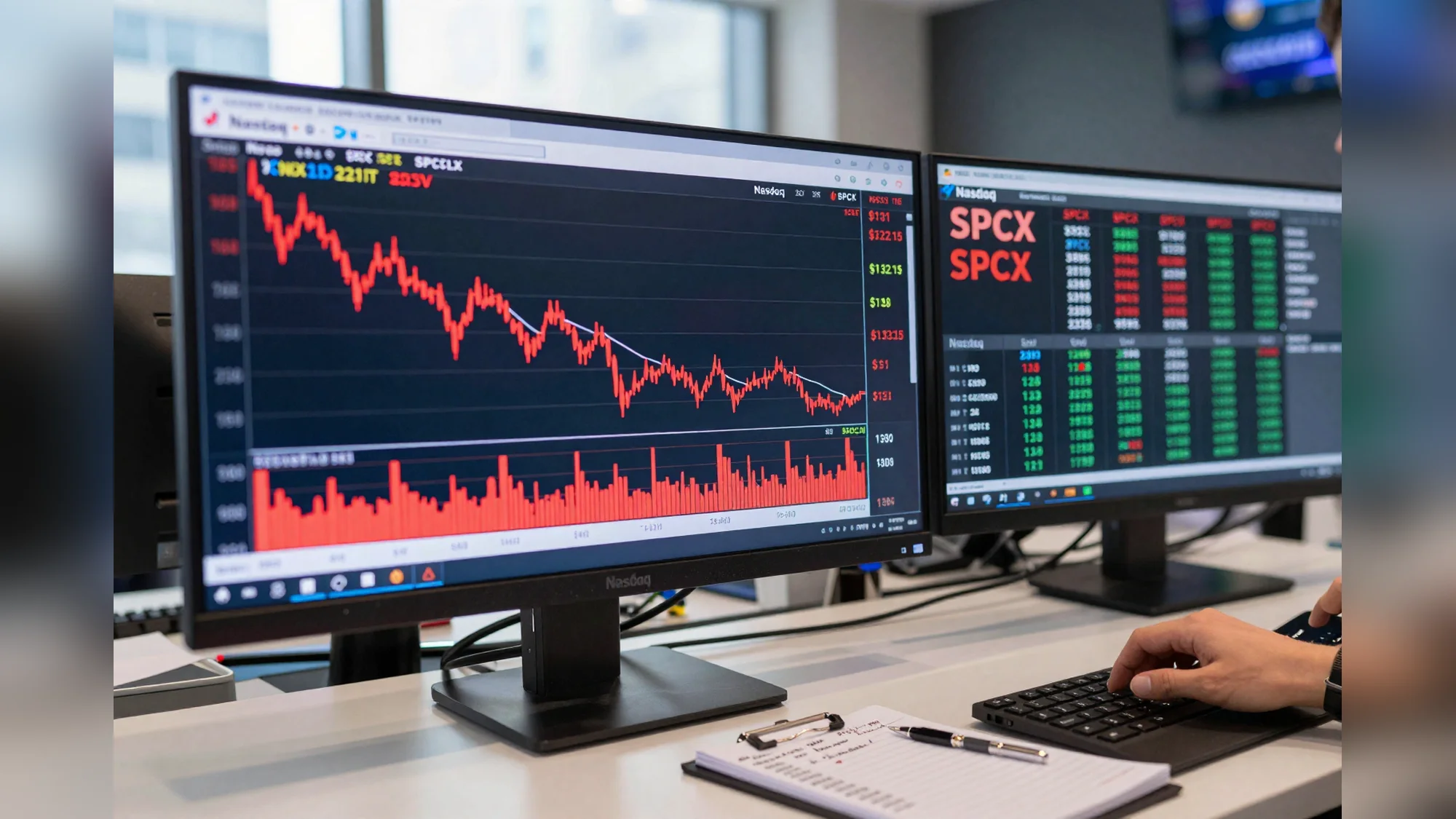
On Nasdaq screens midweek traders watched SPCX fade from its early glory. The stock hit an intraday low of $132.15, trading briefly below the $135 IPO price, and finished Wednesday at $135.27. That movement wiped much of the post-listing premium the share enjoyed after it opened to heavy demand on June 12. Spaceship warned the quoted price probably doesn't reflect broad market value until trading widens.
On the Nasdaq tape the share ticks told a simple story: scarce stock, noisy price moves.
What happened to the price this week?
SpaceX listed under the ticker SPCX and erupted on its first trading day, June 12, climbing to a record high of $161 as buyers chased scarce stock. In the weeks after that debut, buying interest cooled and the rally reversed, with the stock dipping to an intraday low of $132.15 this week before closing at $135.27 on Wednesday. The recent pattern shows how initial gains can unwind quickly when the balance of supply and demand shifts.
Retail and institutional investors who bought SPCX at or soon after the IPO are the immediate group affected by the pullback. Only about 5 percent of the company is in free float; the rest remains locked with insiders, employees and long-term backers. That scarcity means most price moves are set by a handful of shares changing hands rather than a broad market consensus.
Jason Sedawie, vice president of investments at Spaceship, put it plainly: "price discovery simply hasn't really happened yet." He argued the current trading range reflects scarcity and a shortage of willing sellers, so recorded prices reveal little about what a wider market would pay. Spaceship said meaningful price discovery will require higher trading volumes, a broader mix of buyers and sellers, and more time in the public market.
Part of the uncertainty comes from what SpaceX actually sells. The business pairs a fast-growing Starlink satellite internet subscription operation with long-term, capital intensive projects such as the Starship launch system and exploratory AI and space missions. That mix gives clear growth potential but complicates conventional valuation models while most shares stay privately held.
For investors the immediate lesson is mechanical. A narrow float makes the stock prone to swings that reflect trading mechanics rather than changes in fundamentals. Early post-IPO volatility can reverse initial gains quickly when buying interest subsides or when available supply is too constrained to sustain higher prices.
Related Articles
- SpaceX IPO priced at $1.75 trillion, $75bn raised
- SpaceX Accuses Amazon of Launching Satellites at Unsafe Altitudes, Raising Collision Risks
- Tesla share price slips 1.6% as volatility rises
The test is whether trading broadens beyond the roughly 5 percent free float. If volumes remain low, prices will keep reflecting mechanical scarcity rather than genuine price discovery.
This article was created with AI assistance.



