
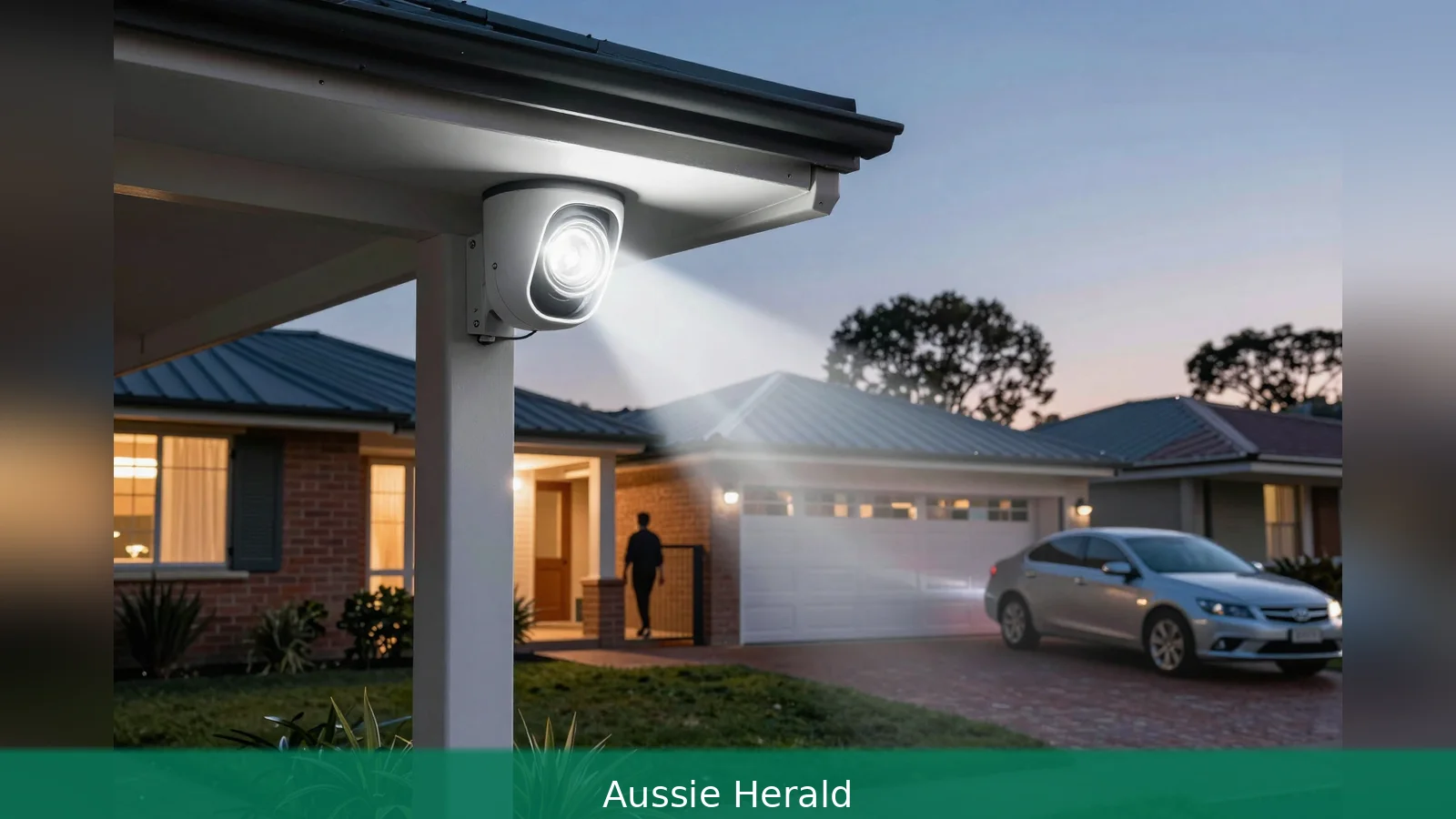
2,000 lumens. That's the practical brightness threshold reviewers use to separate floodlight cameras that will actually light a driveway from those that leave important detail in shadow. PCMag Australia names the Eufy Floodlight Camera E340 as its top hardwired pick; it pairs a 2,000-lumen twin-LED array with a 3K main sensor and mechanical pan and tilt. This guide walks through the nine reviewer-tested steps you should follow so you match brightness, coverage, storage model and ongoing costs to the job before you buy.
2,000 lumens. Start there when you choose a floodlight camera because lumen output determines whether a unit will give usable colour night vision and illuminate a full driveway or yard. Reviews and hands-on testing from PCMag Australia, Mamalinux and Consumer Tested Ratings converge on the same practical taxonomy: wired floodlight cameras sit in the 2,000 to 3,000 lumen band and deliver the continuous power needed for bright, reliable lighting and 24/7 recording. Battery and solar models trade peak brightness for installation flexibility and typically stay below 1,000 lumens to preserve runtime.First, measure the area you want lit and decide how much continuous illumination you need. If you want to fully light a long driveway or cover a broad front yard, aim for a hardwired fixture in the 2,000 to 3,000 lumen range. PCMag Australia and other reviewers advise picking a hardwired model when you have an existing outdoor junction box because continuous power supports higher lumens and constant recording. Second, if you don't have access to mains wiring, accept that battery or solar floodlight cameras are better for secondary entries and locations without a junction box but will usually produce under 1,000 lumens and need periodic servicing.
Practical example: a single hardwired 2,000-lumen unit can illuminate a typical suburban driveway and enable colour night vision at common residential distances. A battery model under 1,000 lumens may work well for a side gate or covered porch, but it will struggle to give the same readable detail down a long driveway.
First, choose resolution to match your identification needs. Reviewers repeatedly recommend 2K or higher imaging to reliably identify faces and read licence plates at typical residential distances. PCMag highlights the Eufy E340 for pairing a 3K main sensor with mechanical pan and tilt, noting its ability to deliver readable detail at typical residential distances. Second, think about coverage. Mechanical pan and tilt is rare but useful on larger blocks, because one device can cover areas that would otherwise need multiple cameras.
Worked example: if your goal is a single-device solution for a wide front yard, a dual-lens, pan-and-tilt model can cut blind spots and reduce hardware counts. Consumer Tested Ratings and Mamalinux note that dual-lens or mechanical tracking sharply reduces the number of units you need to buy and maintain for wide drives and yards.
First, pick a camera with detection modes that match the location. Ring models are often praised for advanced detection, featuring radar-enhanced 3D motion sensing and configurable motion zones that reviewers say reduce false alerts from passing cars and trees. Eufy and other brands commonly offer person, vehicle and pet detection plus auto-tracking, though Mamalinux recorded occasional AI misclassification in extended testing.
Second, choose models with robust motion-zone editing when false alerts are a major concern.
Practical scenario: if your street has frequent passing traffic, a unit with radar-assisted 3D sensing or strong zone editing will send fewer useless alerts to your phone. If you live on a quiet cul-de-sac and want any movement recorded, simpler detection settings are fine.
First, understand the subscription trade-off. The subscription model is the largest long-term cost variable reviewers highlight. Some brands, notably Eufy and Wyze, emphasise local storage or microSD-based free tiers that let you retain footage without a monthly fee. By contrast, Ring generally saves recorded history behind a paid subscription in the reviewers' testing notes. Second, if 24/7 retained footage without cloud fees matters to you, prioritise devices that explicitly advertise continuous local recording or support large onboard microSD cards.

Example choice: if you want subscription-free continuous recording, a hardwired Eufy model with local storage is a sensible fit. If you prefer cloud convenience and accept the recurring cost, Ring or Arlo ecosystems give polished cloud features and wide third-party integration.
First, test how the camera's app and ecosystem fit with your existing devices. Arlo and Ring retain broad third-party compatibility, which reviewers like because it helps when you want multi-device automation. Second, value app reliability. Mamalinux and other reviewers warn that app stability and firmware update cadence matter as much as raw specs because practical usefulness depends on stable notifications, reliable person alerts and timely firmware fixes.
Practical note: if you already use Alexa or Google Assistant, pick a camera with tested integration in those ecosystems to reduce friction. If you rely on a vendor-supplied base station, check whether that base station is included or sold separately; some reviewers flag that certain devices function best with a vendor base station for stability and added local storage.
First, confirm the mounting and wiring situation at the chosen location before you buy. If replacing an existing exterior fixture, many reviewers say swapping in a hardwired floodlight camera is straightforward for those comfortable with basic wiring. Second, if you lack a junction box, expect to accept lower lumen output and occasional battery maintenance with wire-free models. Some models also require an additional hub to unlock advanced features or local storage, so check whether a base station is included. Mamalinux notes this is especially the case for certain devices.
Practical example: if you want the performance of a 2,000-lumen hardwired unit but lack a junction box, budget for an electrician to add one or choose a battery model and accept the trade-offs in brightness and runtime.
First, check siren output and two-way audio quality. Reviewers note that a loud siren combined with bright floodlights often deters intruders before escalation. Second, compare two-way talk. Some reviews found certain Ring models offered clearer two-way talk than many rivals thanks to array microphones and noise cancellation.
Use case: if you want to confront a visitor remotely, prioritise a model with clear two-way audio and a loud siren. If deterrence is the goal but you rarely intend to talk through the camera, a strong light array and good detection may be enough.
First, calculate the total cost of ownership including subscriptions and maintenance. Across reviews, total ownership depends heavily on whether you prefer local storage or cloud playback and whether you accept occasional battery work. Reviewers emphasise that a no-subscription camera with local recording can save hundreds of dollars over a few years compared with a subscription-dependent model, even if the initial purchase price is higher. Second, if convenience and advanced cloud features are important, accept that subscription services add ongoing fees but can deliver features otherwise unavailable without a vendor plan.
Decision exercise: if saving over time matters more than immediate convenience, choose a local-storage device. If you want seamless cloud history, face-recognition features or broad remote access without local hardware, factor subscription fees into your long-term budget.
First, pick the specific model family that fits your situation. The reviewers converge on clear use-case recommendations: choose a high-lumen, pan and tilt, hardwired model for large properties that need single-device coverage and subscription-free 24/7 recording. Second, choose a battery-powered model for remote locations without wiring. Third, pick Ring if you prioritise advanced motion detection and broad ecosystem integration and accept subscription fees for clip retention. Budget options such as Wyze and certain Reolink models are recommended where cost and local storage are priorities and ultra-high lumen output isn't required.
Concrete matchup: large property plus local recording, a high-lumen hardwired model. Remote cabin without wiring, a battery-style model. Street with frequent traffic and a desire for precise alerts, a device with radar-enhanced detection and configurable motion zones.
In short. First, begin your purchase process by confirming the power and mounting situation at your chosen location. Second, if you have an existing outdoor junction box prioritise a hardwired unit rated 2,000 lumens or higher for full driveway and yard illumination. Third, if you lack wiring opt for battery or solar models but accept lower peak brightness and periodic maintenance.
Related Articles
- 3 AIs Compared: ChatGPT, Claude, Gemini in 2026
- Tax File Number cost: Free, but missing one can cost 45%
- 20% cut to HELP debt: how to confirm and what to do next
If you have an outdoor junction box, prioritise a hardwired floodlight camera rated 2,000 lumens or higher: that single fact is the clearest decision point reviewers return to when recommending the right camera for full-driveway and yard coverage.
This article was created with AI assistance.


