
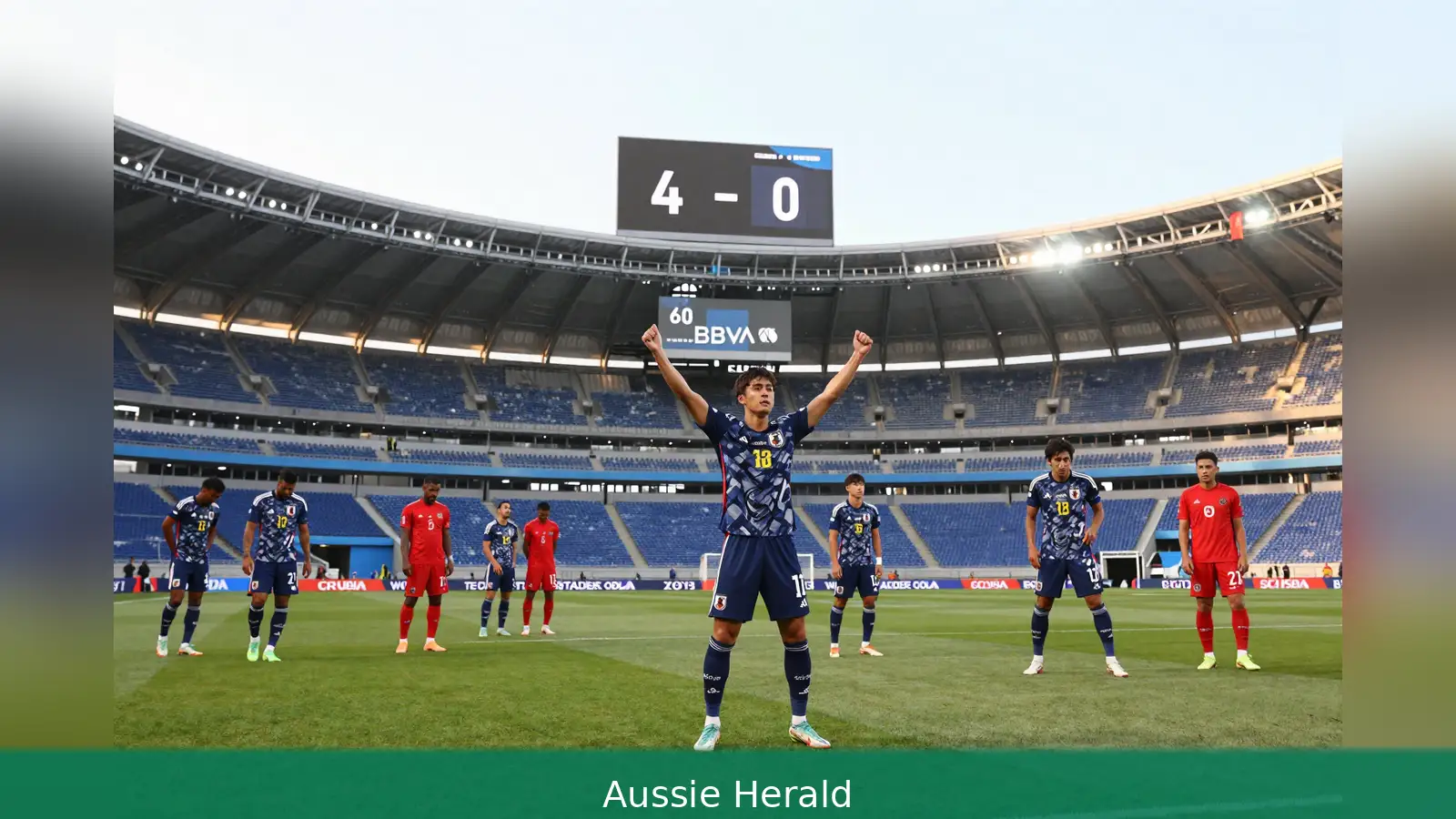
Ayase Ueda was directly involved in three goals as Japan thrashed Tunisia 4-0 at Estadio BBVA in Monterrey, a result that all but ended Tunisia's World Cup hopes and settled much of Group F. The match, watched by about 50,000 fans, carried the tournament's 1,000th fixture label. For Australian viewers the kick-off was Sunday AEST June 21 at 2:00 p.m., with live coverage listed on SBS. International windows named before the match included BBC One in the UK, Fox Sports in the United States and Zee5 in India. After the result Tunisia will now need an unlikely win over the Netherlands in their final group game to retain any mathematical chance of progressing.
1. How to watch and where to find replays
Estadio BBVA in Monterrey provided the setting and a clear time anchor for fans converting kickoffs around the world. Australian viewers were pointed to SBS for live coverage of the Japan-Tunisia fixture, which kicked off in Monterrey and corresponded to a Sunday afternoon AEST slot on June 21, 2:00 p.m. The match was also listed in pre-match information among international windows that named BBC One in the UK, Fox Sports in the United States and Zee5 in India. Those named broadcasters were the practical ports for live viewing or official highlights in their regions.
If you need a replay or a condensed match, the primary place to check first is the broadcaster that held rights in your territory. For Australians, check the SBS schedule and the SBS streaming platform for replays and edited highlights following the live broadcast. Broadcasters typically post full-match replays or two- to ten-minute highlights packages in the hours after the final whistle, subject to their platform rules and regional rights.
Worked example: if you missed the live game and you are in Sydney, search SBS's streaming catch-up for "Japan v Tunisia" on the June 21 programming page. If you are outside Australia, use the named window for your country: BBC One audiences should look at the BBC sport pages and iPlayer highlights, while US viewers should consult Fox Sports platforms and Zee5 for viewers in India. For authoritative match records and finalised statistics, use the FIFA match centre which standardises goal scorers, minute-by-minute events and disciplinary records.
2. What was at stake before kick-off
The tension before this match came from a compact Group F table and a straightforward mathematical picture. Tunisia had been hammered 5-1 by Sweden in their opening fixture and arrived at Monterrey under intense pressure, needing a win against Japan to keep realistic hopes of progression alive.
Japan, by contrast, had taken a point from a 2-2 draw with the Netherlands and could secure progression to the knockout stage with a win.
That mix of results shaped team selection and the tone of the contest. For Tunisia the match was described in previews as essentially do-or-die. Anything less than victory would leave their qualification fate dependent on the final group game against the Netherlands, a scenario the coverage that followed the match labelled highly unlikely. For Japan the opportunity was to convert possession and attacking control into three points and the clearer path through Group F.
There was also a symbolic angle. Broadcasters and preview coverage had flagged this fixture as the 1,000th match in World Cup history, a milestone commentators referenced before and after the game. The milestone didn't alter tactics, but it added to the occasion at Monterrey's stadium and framed the fixture in tournament history.
3. The managerial context for Tunisia and how it shaped the match
In the days between Tunisia's opening defeat and the Japan game the Tunisian Football Federation made a decisive change in leadership. Sabri Lamouchi was sacked after the 5-1 loss to Sweden and Hervé Renard was appointed to take charge for the match with Japan. Coverage highlighted the abrupt nature of the switch and emphasised how limited Renard's time was to put in place any major tactical overhaul.
Renard arrived with a reputation for experience at major tournaments and with African national teams, but the brief window to prepare meant his options were constrained. Preview pieces suggested Tunisia would try to shore up defensive organisation and rely on set pieces, the familiar profile for the team in tournament football. In practice, the late managerial change became a complicating factor rather than an instant cure for the defensive problems exposed against Sweden.
4. How the match unfolded and the decisive events
A scene that repeated across match reports was Japan's early control of the ball, quick transitions and a press that repeatedly unsettled Tunisia. Japan built a multi-goal lead that left Tunisia with no realistic route back into the game. Match reports noted the fixture ran without controversy over officiating in the post-match accounts.

Japan finished 4-0 winners at Monterrey. Ayase Ueda was directly involved in three of the goals: he scored twice and registered an assist, with other team-mates adding the remaining goals. The timing of the goals and the sequence of Japan's pressing and finishing removed any realistic chance of a Tunisia comeback, according to match coverage.
Journalists highlighted that Japan's style in the fixture combined fluid passing with high-tempo transitions and an ability to press effectively. Those strengths breached Tunisia's defensive structures repeatedly, whereas Tunisia's reliance on defensive organisation and set-piece threat didn't materialise into an attacking response enough to change the scoreboard.
5. Tournament consequences and what the result means for Group F
The result reshaped the Group F table. Japan's victory placed them alongside the Netherlands at the top of the group on points and goal differential, advancing their position toward knockout qualification. Post-match analysis made clear that Tunisia's heavy opening defeat to Sweden and the loss to Japan eliminated them from contention for the knockout rounds.
Tunisia now faced a simple but severe mathematical reality: their only remaining path to the knockout stage required beating the Netherlands in their final group fixture. Given the points totals and goal differences recorded after two matches, coverage described that route as highly unlikely. The Japan result, therefore, was decisive not only for Japan's progression but for eliminating Tunisia's group-stage hopes.
For Japan, the win reduced pressure heading into their remaining fixtures and left them in a stronger position to manage squad rotation and tactics with one eye on knockout planning. For the Netherlands, the standings after this round meant they shared top points but still had the group undecided until all matches played out.
6. Tactical takeaways and selection notes
Pre-match analysis had flagged that Japan might adapt their approach from the Netherlands game, when they leaned on quick counters, to a version focused more on possession and controlled pressing against Tunisia. Match reports confirmed Japan's adaptability: their fluid passing, capacity to press high and speed in transition were decisive. Junya Ito's impact off the bench in the opener had been a tactical variable identified beforehand; in Monterrey he was part of the attacking rotation that produced goals.
Tunisia's profile in previews emphasised defensive organisation and set-piece reliance, but Japan repeatedly breached those structures. The late appointment of Hervé Renard gave the team managerial experience but little time for structural reset. That lack of preparation appeared in the ways Japan found space and finished chances, and it was a recurring theme in post-match commentary.
Selection-wise, Japan's forward line found regular service and finishing opportunities, with Ayase Ueda the central figure in the scoring sequence. Match coverage singled out his two goals and his assist as the core reason the scoreline widened so quickly.
7. Where to find official records and what to check next
For a verified account of scorers, bookings, and the official timeline of events, consult the FIFA match centre and the competition standings page. Those feeds are the sources that standardise the final scoreline, goal scorers and cards for tournament records and statistical databases. Broadcasters named before the match are the primary places to find replays and highlight packages in their regions.
Practical follow-up for Australian readers: check the SBS schedule and streaming platform if you want the full match replay or a condensed highlights package. For official confirmation of scorers, disciplinary records and tournament standings refer to the FIFA match centre which compiles the standardised match data released after every fixture.
If you are tracking Tunisia's route out of Group F, note the simple next step: Tunisia must defeat the Netherlands in their final group fixture to retain any mathematical chance of progression. That match is the next decisive fixture for Tunisia's qualification hopes and the place to watch if you want to see whether their tournament continues.
In Short
First. Japan beat Tunisia 4-0 at Estadio BBVA in Monterrey, a match that was the tournament's 1,000th fixture.
Second. Ayase Ueda scored twice and supplied an assist.
Third. The win put Japan level with the Netherlands atop Group F.
Fourth. Tunisia were eliminated from knockout contention and must beat the Netherlands in their final game to keep any mathematical hope alive.
Related Articles
- 2-2 draw leaves Iran and New Zealand level in Group G
- Why Swiss AI projects blew budgets in 2026: 10 costly obligations
- Apply for an Australian passport: allow six weeks
Tunisia's final group fixture against the Netherlands is now the only match that can keep them in the tournament, and that single result will decide whether their World Cup ends here or extends to the knockout stage.
This article was created with AI assistance.


